Favorite Travel Quotes

"Stop worrying about the potholes in the road and celebrate the journey." -- Fitzhugh Mullan

"A good traveler has no fixed plans and is not intent on arriving." -- Lao Tzu

Archive for the 'RV Travel' Category

Why the Instant Kinship Among Airstreamers?

posted: July 6th, 2008 | by:Bert

Ricky and Tami Kesel

Ricky and Tami Kesel

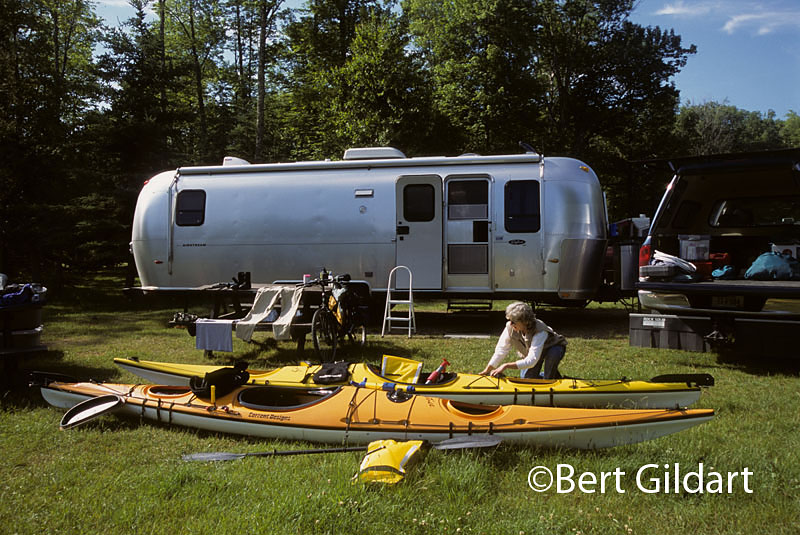
©Bert Gildart: Janie and I missed the International Airstream Rally, held late June of this year in Bozeman, Montana. It’s our home state, but I had obligated myself long ago to attend the OWAA Convention , which I have been covering in my blog postings these past few weeks.

But we didn’t miss the Airstream Rally entirely, or, that is to say, we certainly didn’t miss the dispersal. As we drove the 150-mile span of highway today from Billings to Bozeman, Airstreams coming toward us probably numbered close to 60. And what was so amazing is that every single one of them (without exception!) flashed their lights or flung their arms out of the window to greet us, clear from the other side of Interstate 90, a four-lane highway. Apparently these folks had had a darn good time.

I submit that there is no other road organization that feels such a personal kinship. What’s more that kinship seems to be instant–and you have to wonder why? The attraction transcends socio-economic lines and well as political philosophies. Again, you have to wonder why.

That’s how we meet Ricky and Tami Kesel (and their valued pets in window behind them) of New York, an attractive couple that launched a maiden voyage last month with a 1988 34-foot Airstream motorhome. We saw them going our direction in a Rest Area and were instantly drawn to them.

“Hey, looks like we’re the only Airstreamers going toward Bozeman.”

Continuing, they disclosed that they are now full-timers, having recently retired as a husband-wife cross-country truck driving team. Periodically they hope to participate in the work/campers program-and see America!

But what then would the Gildarts and Kesels have in common with all the others who use Airstreams?

A UNIVERSAL CACHET?

Though that is hard to pinpoint, I’m guessing it is the spirit of adventure that the name Airstream seems to invoke. Historically, individuals and groups of Airstream caravaners have traveled to all parts of the world, so the brand has a certain universal cachet. Without any conscious effort owners then live up to the image because adventure is in their blood–and possession is simply an extension of their psyche.

There’s something more, too. Because Airstreams are not cheap, it means people who now own them have thoroughly investigated their wants and needs and then planned and implemented well. In other words, there is great pride in ownership resulting from an attractive brand that is well assembled. Their Airstream is more than utilitarian, it makes a statement that says: “We enjoy traveling; it’s where we are at this stage of our lives–and we want to do it well. ”

Please understand that I’m not saying that those who own other brands of RVs don’t share all the above-mentioned qualities. And I’m certainly not an elitist! All I’m doing is trying to offer suggestions that might explain why those driving other excellent brands such as Tiogas, Winnebagos, and Jaycos, what ever have you… don’t share this instant recognition that produces hand waves and flashing lights. Airstreamers do; and that’s a fact! And it’s not just around rally time.

At any rate, you put all this Airstream stuff together: You combine, a spirit of adventure, pride in ownership, and certainly the desire to see new places and meet new people, and maybe that’s a start at unraveling this puzzle of instantaneous kinship.
On a more personal note, Janie and I tow our 28-foot Airstream Safari with slide out because it tows so darn easy. Maybe that’s all there is to it. Certainly one of the 70 or 80 Airstreamers we saw today who have just departed the rally can do a better job of answering the question than can I.

Care to try?

*PREVIOUS AIRSTREAM POST (Picked up last year by the Airstream Forum): Airstream Camper Tips

Read Comments | 1 Comment »

Reflections On the Badlands–As We’re Heading Home

posted: July 5th, 2008 | by:Bert

"Lonely" Bull Bison

"Lonely" Bull Bison

©Bert Gildart: From across the campground the man with Minnesota tags who had just pulled into his site called out with a statement, then a question.

“Hey,” he said, apparently referring to the pink liquid in our glasses. “They don’t allow this is Minnesota. Watch it now!”

Flabbergasted, we simply remained silent, which apparently didn’t satisfy the white-haired man. Reaching into his cooler, he brought over several pops, apparently to replace what he thought was wine in our glasses with something more in keeping with his own religious dictates.

“Wouldn’t you prefer this instead?”

“No thanks,” we said. “But would you care for some of what we’re drinking?”

In the past couple of years of travel, Janie and I have learned that you meet all types of people on the road, and that in many cases, they have no compunctions about imposing their beliefs. Yesterday, it may have been the heat, for out here on the Great Plains the temperatures have been hovering close to 100.

Or maybe it’s something else. Perhaps it’s because he was lonely and knew of no other way to interact. The RV life is great, but it sure makes it better when you have someone to share both the highs and the lows.

PHOTO TECHNIQUES

For the past couple of days, Janie and I have been working hard trying to capture both the spectacle of the Badlands and the beauty of the wildlife that occupies these incredible formations. Certainly one of the most impressive species in the Badlands is the bison, but photographing them against the light-colored Badlands would have been a challenge with film. But the digital age has changed that-but only if you understand PhotoShop, and know what you can do with the different digital formats.

Certainly you can shoot high-res jpgs, for with this format you can bring the highlights and the dark areas together providing they are separated by no more than a stop or two.

But in this exceedingly contrast-y scene there was more than a one-stop separation, so I shot Raw. Then, loading the image with Adobe Browser in Photoshop CS3, I easily added detail to both the dark areas and to the very light-colored Badlands. Film would have washed out one or the other, depending on which you area you exposed for. So, too, would an image shot as a jpg.

I wanted a good photo of a bison in the Badlands to help illustrate some thoughts I’ve been having recently about one of the worst chapters in American history: the forced eviction of the Lakota Sioux from land granted to them by treaty. Part of this eviction was accomplished by the slaughter of the bison in this very area. The government wanted the Sioux to cease their nomadic ways, and thought to bring about that transformation by converting these people into farmers. In that way the nearby Blackhills would be available to white settlers who wanted to mine for gold.

Today, bison once again roam the Badlands, but they are closely managed to prevent them from proliferating and soon overgrazing their allotted land. Here in the Badlands, it’s mating season for these lords of the plains, and this huge and lonely bull was looking for a mate.

FOURTH OF JULY

Last night we watched a Fourth of July Fireworks display out the back window of our Airstream. The good folks in Hardin, Montana, put on quite a show and how lucky are those of us who have someone with whom to share such spectacles. Alone, there might have been the tendency to elevate a person from the sin of drinking wine, which I must admit we were doing when the man attempted to replace our drink of the moment with cans of pop.

Read Comments | 1 Comment »

Huge Hail, Snake in the Grass & Other Travel Trivia

posted: June 19th, 2008 | by:Bert

Snake In-the-Grass

Snake In-the-Grass

©Bert Gildart: Erick Hanson is generally a reticent man, but yesterday at Montana’s Little Bighorn Battlefield, he hollered out loudly. “Watch it;” he hollered. “Snake!”

Erick was yelling at Dave Vedder and there was a real reason. We were hiking along a trail to the Reno-Benteen hold out, when Erick heard a rattlesnake. Dave was no more than four feet from it, and the snake so blended with the grass that neither David nor I saw it nor did we hear the rattle of the rattles. But Erick sure did! And fortunately, he let us know.

HUGE HAIL

That was not our group’s first lucky break in the past 24 hours. The night before while camped in a KOA located about 15 miles from the battlefield, the wind had swelled and it blew with a fury, battering the three RVs our group was now driving on the way to Bismarck for the annual Outdoor Writer’s convention. Thick rain and silver-dollar-size hail had accompanied the wind, and the next morning I rose at the crack of dawn, fearful the pounding had mangled the aluminum on our Airstream. Because of our concerns, neither Janie nor I had slept that night.

The cracking noise of the hail inside the trailer had been deafening, but as I looked around, I could find no denting, which simply amazed me. Likewise I examined another nearby Airstream, but it, too, appeared OK. However, I then walked over to a utility trailer also made of aluminum, and the entire shell of the man’s cargo trailer was pitted in a way that was sickening.

OTHERS NOT SO LUCKY

Apparently (as one would hope) the Airstream’s aluminum is of a very high quality, but I knew that if the hail had been a bit larger we might not have been so lucky. The year before I’d seen an Airstream Bambi pitted from what the owner said had been huge, almost apple-sized hail. That’s somewhat freakish, but still, it can happen.

Peace & Unity

Peace & Unity

And so after thanking the Great Spirit that morning for sparing us, we carpooled from the KOA to the Battlefield, encountered the rattlesnake and then made our way to the new Indian Memorial.

NAME CHANGE

As a writer and photographer, the battlefield has been good to me, and I’ve worked with the park historian on various stories for a number of magazines. Recently, two of the battlefield’s superintendents have been Native American, and one of them, Gerard Baker, has become a good friend. He’s a man I first met at Theodore Roosevelt National Park where he’d been serving as a ranger, and we immediately hit it off because of our love for Ray Charles and for blues music in general.

Not all work for Sue

Not all work for Sue

Several years later the park transferred Baker to Little Bighorn where he was instrumental in securing a name change. It has not been easy, and he had even weathered several death threats.

Previously, the battlefield had been called Custer Battlefield, but, now, rather than celebrating the person who lost and was responsible for the death of over 220 men in his command, the park with its new name celebrates those who won a battle. Now the park celebrates the victory of Crazy Horse, Sitting Bull and other Lakota Sioux and Northern Cheyenne in a way intended to set aside the animosity that has cropped up during the year, for the theme of the Indian Memorial is “Peace and Unity.”

That message is symbolized through an open slot in the memorial that leads the eye to the obelisk on Last Stand Hill listing the names of all those fallen 7th Calvary soldiers.

CELEBRATING THE SETTING SUN

Our time at the battlefield was limited and so we scurried back to the KOA, loaded up our respective campers and then proceeded on, driving four hours to Makoshika State Park, still in Montana. Pam Vedder and Sue Hanson mixed up a batch of Gimlets using their battery powered blenders, Dave fired up a portable barbeque to cook salmon he’d caught only the week before in the Queen Charlotte Islands, and in that way we recounted all of our good fortune. The snake had not bitten either Dave or me, and none of us had sustained any damage to our RVs.

Celebrating the Setting Sun

Celebrating the Setting Sun

And so we celebrated the beauty of the setting sun and the fun all six of us were now having as a group.

Read Comments | Post a Comment »

Springtime in Glacier National Park

posted: May 19th, 2008 | by:Bert

Airstream backdropped by Divide Peak

Airstream backdropped by Divide Peak

©Bert Gildart: For the past three days Janie and I have been exploring spring in Glacier National Park. It hasn’t been particularly easy as campgrounds on the east side of the park are all closed, though expected to be open in about a week on a very primitive basis.

However, the KOA Campground at St. Mary is open, but then it is much lower in elevation and, therefore, is now snow clear. Not so, however, the park, where some of the more exciting and more lofty campgrounds are still filled with snow.

So, too, are some of the roads. Nevertheless, for the person with some spirit of adventure, there’s much to do.

BICYCLING IS GREAT

We found we could drive the road from near East Glacier toward Two Medicine and then park (Airstream and all) at the Running Eagle parking lot. Past this point, the road is snow free, but the road remains closed. Flooding is anticipated and some portions of the road could be difficult drive.

But you can bicycle the road, and that’s what I did, pedaling about two miles uphill to the Two Medicine Lodge, still closed and completely engulfed with snow.

LAKE PARTIALLY FROZEN

Interesting, I also found Two Medicine Lake to be partially frozen, but what a photo opportunity the lake provided all backdropped by Sinopah Mountain. Though the campground here will be open in about a week, at the moment, most campsites are banked with old spring snow.

Road to Two Medicine Chalet

Road to Two Medicine Chalet

From Two Medicine, we pulled the Airstream over Looking Glass Hill, descending to Kiowa Junction, then about 10 miles further, past the turn off to my old ranger station located along Cut Bank Creek. Later, we returned and did visit the ranger station, and this time both Janie and I bicycled the mile long section of this dirt road that wasn’t yet open either to vehicular traffic. Later this week, we’ll be providing some reflections on my days at Cut Bank.

TRAGIC FIRE

From Cut Bank, it is about another 15 miles to St. Mary, passing first over Divide Peak and then descending the northern flank that passes by one of the park’s most tragic burns. Just two years ago, the St. Mary Fire almost devoured the small settlement, and I’ll be posting here in yet a few more days photos of the devastation, and what might now be expected. As well, Janie and I also hiked the area, and we’ll be posting photos of our four mile hike that passed through some of the most incredible flower displays the park provides.

Sinopah Mountain

Sinopah Mountain

Our three days in the park in early spring was a trip we’ve been wanting to make for some time, and we are delighted we could squeeze out the time. Drop back throughout the week and we’ll be posting more Glacier photographs and providing a few reflections of the 13 years I spent in this incredible park.

Read Comments | Post a Comment »

Soiled Doves, Lingering Winter and the Charm of The Nugget Campground

posted: May 2nd, 2008 | by:Bert

Airstream and Snow-packed Lookout Pass

Airstream and Snow-packed Lookout Pass

©Bert Gildart: Yesterday, as Janie and I crossed Lookout Pass (separating Montana from Idaho), we discovered a new substance.

Natives call it snow (rhymes with glow) and in places it was so deep that it towered over our Airstream. We quickly discovered the substance is wet, very cold–and that at this time of year the banks are dark with thousands of pine needles and certainly don’t glow. Then, last night, we actually discovered how this stuff is made, for tiny hard flakes starting falling from the sky. To compound matters, this morning we awoke in a campground in St. Regis (just over the border and in Montana) to discover our water hose was stiff as a rod, which means it F-R-O-Z-E.

After four months in the desert, these phenomena are foreign to us, but it appears as though winter has not released her fierce grip yet on Montana and that we’ll learn more about these features before the month of May is over. That, at any rate, is what our neighbors from Bigfork told us–who joined us for the last leg home. They’re new to RV camping and wanted to rendezvous with us somewhere along the way. Originally, we’d mentioned Oregon, but Oregon was so rainy we all agreed that Montana (cold as it can be in late April/early May) might be better. So here we are now in St. Regis, all bundled up, rain free, but surrounded by banks of lingering snow. Apparently so much of the stuff remains that the words “June flooding” are now on the lips of weathermen.

SOILED DOVES

Most campgrounds are still closed but not “The Nugget,” one of the nicest campgrounds we’ve discovered in a long time. First, it’s ideally located, offering biking, fishing and hiking–all in a short radius. Equally as important, Jim and Shirley Shotwell, the relatively new owners, have created a personality for their grounds, imparting an old mining atmosphere.

Brothel & Soiled Doves

Brothel & Soiled Doves

Near the entrance they’ve brought in old mining structures, and then added ambiance. “Soiled doves” were always a part of the mining atmosphere and the nearby town of Wallace, Idaho, is famous as a town that has preserved all aspects of its mining history. The town’s “Bordello Tour” and its summer playhouse performance (”There Ain’t No Sin In Wallace”) is well known in the Northwest.

Above is our contribution to that theme, obviously posted in a joking way. However, to the lonely men who lived here during those times women were scarce and bordellos probably did much to reduce violence, always on the cusp. Elsewhere throughout “The Nugget,” Jim and Shirley have artfully placed old farm implements and mining paraphernalia. The campground has the Good Sam stamp of approval and, as one would expect, is immaculate. We’re talking about a multi-family get together and agree the Nugget would be ideal.

Later today, Janie and I will return to Bigfork. We’ll de-winterize the house, WINTERIZE the Airstream and begin preparations for other upcoming travels. Despite rising gas prices, they will be many.

Read Comments | Post a Comment »

Airstream Updates Simplify Work

posted: April 26th, 2008 | by:Bert

Janie at Airstream Work Station

Janie at Airstream Work Station

©Bert Gildart: We’re in Salem, Oregon, attending the Northwest Outdoor Writer’s Association. The convention includes lots of seminars, and perhaps most importantly, enables us to make new contacts and renew acquaintances with old friends. The convention also provides supporting members with the opportunity to acquaint us with new products.

Two days ago I met, Mike, the PR man for Toyoto, and had the chance to learn more about their line of pickups (such as the Tundra) and their SUVs.

But more interesting, Mike and I shared a mutual interest in the Gwich’in, and he has traveled through some of the same Arctic lands that Janie and I have traveled. Go to our Home Page and you’ll see the Gwich’in have figured so significantly in our lives that one of my pages is devoted to the Arctic Refuge and the dependency of the Gwich’in on the refuge.

Like us, Mike has thrilled to the passage of throngs of caribou through this sensitive land. As well, we’ve both spent time in the Canadian Arctic, but he has been to Hershel Island, located near the mouth of the McKenzie. The fabled river flanks Gwich’in Indian land, and one day, I’d like to visit this old whaling stopover.

AIRSTREAM UPDATES

But other meetings are just getting started and so this seems a good time to share some updates we’ve made to our Airstream. Several weeks ago, while in Tucson, I visited with the Airstream dealer about installing an inverter I’ve carried loose for the past few years. I wanted to have it installed to an area of the trailer that would enable me to use it without wires running all over the floor–because 12V outlets are remote.

Airstream suggested they link it to the wires from the stereo located immediately above the Airstream’s work station. They created a permanent installation and now, when we have no 120 electrical hookups, we have easy access to a 12V energy source.

ELIMINATING HOOKUPS

As well I purchased a much smaller inverter which now provides power for our TV, meaning that we can remain pretty much independent of commercial campgrounds. Of course we need a source of power to keep our batteries charged, which we had in the desert. Sun and our solar panels kept the batteries fully charged.

Permanently installed inverter

Permanently installed inverter

That will also work in the Northwest when the sun shines, but when it doesn’t, we’ll have to rely on our generator, a Honda generator in our case, which operates at less than 50 decibels, and so is fairly unobtrusive.

All totaled, our expenses for these new modification was about $80. That, however, does not include the pure sin wave (required for a computer) 300 watt inverter we purchased about five years ago when we bought our first Airstream. These additions (cost about $300) mean we can work anywhere, watch TV (or movies) without the necessity of commercial hookups.

Our meetings conclude tomorrow, but tonight is the big night for Janie and me, for this is banquet night and the night Janie and I get a chance to see how our small part goes over. As mentioned in previous posts, we have about 24 “mystery” items we display. They’re all related to the outdoors and are intended to test the knowledge of all these outdoor writers, but in a way that provides a few chuckles.

Read Comments | Post a Comment »

World’s Eighth Wonder?

posted: April 23rd, 2008 | by:Bert

World's Eighth Wonder?

World’s Eighth Wonder?

©Bert Gildart: Though most of us have probably never heard of Burney Falls, Theodore Roosevelt, probably our most noted conservation president, pronounced the hundred-yard long lip with its thousands of plunging rivulets “One of the wonders of the world.”

Our acquaintance with this northern California park, known officially as McArthur-Burney Falls Memorial State Park, was purely accidentally. Tired from so much driving we pulled off the Volcanic Legacy National Byway and into the park.

The park is located on the Modoc plateau halfway between Mount Shasta and Lassen Peak, and we should have suspected that any area located between two such spectacular areas would itself be spectacular.

WORLD’S EIGHTH WONDER?

Still, it was the camping that initially lured us there, for with the exception of but two other campers, we had the park all to ourselves. Maintenance people said that’s the way it is before Memorial Day and then again after Labor Day.

After setting up our Airstream, we walked to the overlook and began taking in the scenery. The park offered a 1.25 mile long nature trail, well laid out with interpretive signs posted along the way. Geological conditions, we quickly learned, converted the 50- to 60-foot wide stream into wide basaltic plateau over which millions of gallons of water dropped each day.

Hundreds of mini falls cascade over 130 feet

Hundreds of mini falls cascade over 130 feet

Though water from this falls was primarily confined to two major drops, still there were hundreds of other mini cascades. Together they created a resounding roar and then, as they splashed almost 130 feet into the pools below, a mist swept up and then drifted over the trail below.

TALUS SLOPE

From the pool, the trail paralleled the creek and passed a number of yet other features the park celebrated with interpretive panels. One area that stopped us short was a talus slope created from black basaltic chunks of rock. The sign said that the slope was the result of erosion of the softer strata and that eventually that erosion caused the lava layer to collapse, leaving behind the near-vertical talus slope that descends into Burney Creek. The slope provides mute testimony that once-in the geologic past-the falls existed here.

Talus Slope plunges into Burney Creek

Talus Slope plunges into Burney Creek

Because it was spring in this part of the country, the trail was also lined with various species of vegetation now in bloom, most notably the greenleaf Manzanita, which in Spanish interprets as “little apple.” The species is fire resistant, and grows back quickly after a fire. However, it burns hot when ignited.

Several other species also flank the trail to include Mountain Misery (other names are bear mat and bear clover), and this is the northern extension of this species. Other species include Ponderosa, and there is a wonderful display of growth rings near the end of the loop trail. The tree was cross-sectioned and then historic dates included. Dates ranged from about 1500 and ended with the inauguration of President Reagan.

Manzanita or "Little Apple" flank trail

Manzanita or "Little Apple" flank trail

Unfortunately, travel obligations restricted us from staying more than a day, but if we could make it through the snow, sleet and rain we’d heard awaited us on several Oregon Passes, we’d be with good friends Sue and Eric Hansen , who live in Corvallis, Oregon. They’re the couple we rendezvoused with in Death Valley.

WHAT THE HECK IS IT?

Obviously, we made it, then parked in their drive. Sue had a wonderful dinner prepared and then, today, we drove the final 40 miles to Salem, Oregon, site this year of the Northwest Outdoor Writer’s Conference. I’ll be working hard the next day or so preparing for a “What the Heck is it Contest” Janie and I provide for the several hundred participants.

The contest is for the enjoyment of all NOWA members and is intended to test their knowledge about outdoor items-and sometimes our ability to pull the wool over their eyes. Some of the more challenging (but fun) items from the past have included the bacculum (sorry, but you’ll have to look this one up) from a walrus, wolf scat; and ticks preserved in a bottle of formaldehyde. As well, the contest includes the usual assortment, such as fishing lures, and cartridges of various calibers.

This year we believe we also have a good assortment (in part because of much help from Eric) and will share with you our presentation–but not until after it’s over. Sorry, but if you check back in I’ll share with you items which are now classified as Top Secret. In fact, I’ll even have photographs of a few of our more interesting selections.

Read Comments | Post a Comment »

Unknown Marta Becket Created Audience, and a Work of Art

posted: April 20th, 2008 | by:Bert

©Bert Gildart: When Janie and I departed the Amargosa Opera House in late February I was happy with the photographic opportunities that had presented themselves. I’d met a group of Vietnam Veterans who had come to know Marta Becket well. One of the men introduced me to Ms. Becket, and she allowed me to photograph her. (Click to see that posting, and also close-ups of her work.)

INITIALLY MARTA GENERATED AUDIENCE THROUGH ART

When we left, my only disappointment was that I had not been able to take a picture of the immense art work Marta created in the early 1960s when she began her one-woman performance. Because she was unknown at the time, she wanted to pretend the auditorium was full, and so she began painting in an audience on the surrounding walls and on the ceiling. To create the work on the walls required four years; the work on the ceiling, two.

Unknown Becket Painted Her Audience

Unknown Becket Painted Her Audience

To dramatize the setting, I thought that if I could only get into the auditorium when it was empty (See, the auditorium often fills to capacity now!) I might duplicate the times, which was, of course, an auditorium filled primarily with the art work she had created.

Yesterday, luck was with me, for our route to Oregon passed adjacent to the Opera House, and so I called ahead; said I had an assignment (which I do), and asked if I might have a few moments in the auditorium. Permission was granted, and because it required some special techniques, I provide the following:

I took many photographs, all from a tripod and all were long time exposure, ranging from 3 to 12 seconds. I used a super-wide angle 12mm lens–and I bracketed my exposures.

PHOTO TECHNIQUES

Because digital images exposed for several seconds sometimes produces “noise,” or unwanted light points, I went to the camera’s shooting menu and choose “On” to eliminate such possibilities. (Caution if you use this technique, you must have fully charged batteries.)

Over the years, Marta’s work as an artist has been recognized internationally. Currently she spends winters giving her live stage performances and summers creating works of art. Recent clients include the movie actor Martin Sheen. Certainly, Ms. Becket is a talented woman, and I hope my images in this visually reduced format do justice to her immense talent.

Read Comments | 1 Comment »

Things Have Changed

posted: April 14th, 2008 | by:Bert

Tuzigoot Ruins

Tuzigoot Ruins

©Bert Gildart: Two days ago we checked into Dead Horse State Park in Cottonwood (about 20 miles from Sedona) and have been catching up a little on all the work involved with writing stories while on the go. That includes filing digital photographs and then captioning them. Though it may seem as though we do little more than drift from one place to the other, such is not the case.

However, that is not to say that it’s all work either, and the past two days have also included short trips to some of the endless attractions this area offers that can be enjoyed as mini excursions. First on our list was the Indian ruins known as Tuzigoot.

ANCIENT INDIAN RUINS

Tuzigoot is one of the smaller National Monuments, but it preserves an important component of the Sinagua Indian culture. Once the pueblo consisted of 110 rooms, and in an eroded form the park preserves many of them. The rooms comprising the pueblo are perched high on a hill and gaze over the agricultural land the group once farmed. The group occupied the area from around A.D. 1000 to around 1400. Currently the site preserves 42 acres.

Our explorations of Tuzigoot were made two days ago, shortly after we arrived. Yesterday, Rich and Sadira took sympathy on our need to learn much quickly and rendezvoused with us at our campground then gave us another quick tour of the area they call home. If you know the route, the drive from Prescott to Sedona requires little more than an hour.

Striking on a red rock hike

Striking on a red rock hike

One of the activities the four of us share in common is the desire to explore local trails, and we drove first to Bell Rock located just on the outskirts of this very tourist-y town. Art galleries were everywhere and so were adventure exploring stores. One of the jeep touring stores actually had a Native American dressed in very traditional garb trying to lure folks in. He was the only Indian we saw.

We visited several of the stores to include the “Life is Good Store,” and “Rollies Camera” and a health food store.

THINGS HAVE CHANGED

I’ve been here before, but that was 20 years ago, and as we walked around I could not suppress my absolute horror at the way in which Sedona has grown. Gated communities and major housing developments are now creeping on the sides of the beautiful red rock canyons that initially lured these folks here. On the plus side is that most of the homes blend in with their surroundings, for they are all constructed of rock and that rock, of course, is from local sources. Though I’m not sure, I believe Sedona strictly governs the way in which people can build, and that, I think, is good. Sedona, for example, is the only place in the world where you’ll find a McDonald’s Hamburger demarcated by a small purple “M”. No golden arches here.

Oh, that were the way of things back in Montana’s Flathead Valley.

Bell Rock

Bell Rock

Fortunately, some of the land surrounding Sedona remains in public ownership, and that included Bell Rock and the trails that surround it. We hiked one 2-mile long trail that wound through the rocks. Many other people were also hiking (or biking) the trail, but the majority of folks were several miles away in Sedona, shopping. Though I’ll never understand the way in which some people place priorities, I’m glad that’s the way it apparently is.

Our companions were of a similar mind and we hope to see them again soon. As Rich has noted in one of his blogs, that could happen this summer in Bozeman, Montana, for that’s where the International Airstream Rally will be held.

Today, we’re off for a tour of Montezuma’s Castle.

Read Comments | Post a Comment »

So How Do You Like It? Or, Cycling Prescott’s Peavine Trail

posted: April 12th, 2008 | by:Bert

Peavine Trail & columnar rocks

Peavine Trail & columnar rocks

©Bert Gildart: In this day of high gas prices, it is prudent to find a campground that provides various non-motorized forms of recreation. In part that is probably why our good friend Rich Charpentier decided to base himself at Point of Rocks Campground (a superb RV park that provides long-term camping).

About a year ago, Rich pulled his Airstream into this campground and has been here ever since. Yesterday, I found out yet another reason why he’s been so happy with his selection. For one thing, it is close to work for him, but perhaps as important, it provides ready access to some of Arizona’s best cycling.

Apparently he never gets tired of exploring one area in particular–by bike–and neither have I, for yesterday was the fourth time I’ve ridden the area in a week. I’ve discovered you can cycle the 12-mile-long Peavine Trail in about an hour if you push, but not so if photography is your objective. Yesterday, we explored for well over three hours, departing early for the best light. Obviously, photography was our objective.

“SO HOW DO YOU LIKE IT?

Departing Point of Rocks on bikes, within a quarter of a mile (less than five minutes) of extremely wide-shoulder riding, we were cruising into Watson Lake State Park and the trailhead for the Peavine.

The trail passes around an arc of Watson Lake, crosses a bridge near the animal shelter, and then joins Peavine Trail proper. And here is where the geology and history get so fascinating. And here’s where Rich, who remains enamored with his huge backyard begins asking, “So how do you like it, Bert? How do you like it?”

Within a few more minutes the granite mountains–with its hills and spire-like formations that appear so impenetrable–begin to open up. Then, they gobble you up. They do so because stresses within the earth occurred here well over a billion years and eventually created conditions that would form the many jumbles of rocks now littering the landscape.

Rich Charpentier: "So how do you like it?"

Rich Charpentier: "So how do you like it?"

These jumbles are what the trail now passes through–and again, Rich couldn’t help himself:

“So how do you like it?”

As I looked around at the cluster of spires and the fields of boulders that seemed to fold one into another I could do little more than nod my approval.

GEOLOGICAL WONDERS

Geologists use the term to describe the deeply buried molten rock that eventually became today’s landscape as a “batholith.” They explain that the batholith eventually solidified, then cracked–creating all the “joints” that weathering rendered as spires. That, of course, required millions of years.

Today, the effect on those who pass them by is at times profound, as expressed by an unknown author:

“Mighty nature’s whims sometimes produce such grotesque and ponderous jumbles of rock material
that in a place like this man stands in fascinated awe and respectful admiration.”

HIDDEN PASSAGES

We continue our ride, and, Rich, whose enthusiasm continued unabated, explained that the Yavapai Indians once used the area, but that it was later used by miners who brought railroads into the area, and that most of the Peavine was once part of one of the old railroad beds. Adjacent to us as we rode was Watson Lake, and Rich pointed to the dam in the distance. Today, the “lake” provides habitat for a variety of waterfowl as well as a wonderful area on which kayakers can practice and explore hidden passages

Granite Mountain backdrops Watson Lake & kayaker

Granite Mountain backdrops Watson Lake & kayaker

.

But the Peavine opened passages for us, and Rich and I continue to explore the land-based ones with our cameras. Eventually we came to one set of spires and we stopped. Light was streaming in from the side and seemed to be illuminating each of the tall finger-like projections with light that almost appeared celestial. We looked at one another and then almost laughed–for simultaneously the question popped out.

“How do you like it; how do you like it.”

There then followed moments of silence in which we both gazed in admiration.

Note: Janie and I leave Prescott today with much regret, thankful for the time both Rich and Sadira have provided in acquainting us with this wonderful part of Arizona.

Read Comments | Post a Comment »

The Palace: “Arizona’s Oldest Frontier Bar”

posted: April 10th, 2008 | by:Bert

Brunswick Bar, saved from fire

Brunswick Bar, saved from fire

©Bert Gildart: The ambiance is clear the moment you walk into the Palace Bar in Prescott, Arizona. Along the walls, hang images of Tom Seleck, Willie Nelson, John Wayne and others. Along yet another wall hang images of Wyatt Earp, Virgil Earp, Doc Holiday and Big Nose Kate.

This is a western bar–as yet other features attest.

The images and other features are not false advertising; the Palace makes the claim that it is “Arizona’s oldest frontier bar,” and that claim is apparently true, though there was an interruption to its tenure. In 1900 the Palace went up in flames in what is infamously known as the “Whiskey Row Fire.”

BRUNSWICK BAR SAVED

Though the bar burned to the ground, the massive and ornately carved Brunswick Bar shown here was carried across the street to the plaza by patrons. One year later, the Palace was back in business, the Brunswick Bar restored to its original position.

Because of its history, the Palace is certainly a place to reminisce about the Wild West. The Earps all frequented the bar and so did Doc Holiday, often accompanied by his lady friend, Big Nose Kate.

Historically busy--and still busy

Historically busy–and still busy

Holiday died in a sanitarium for tuberculous in Tombstone, but Kate died in Pioneer Home here in Prescott; and before departing this mile-high city, I hope to visit her site, for she was such a western character, as the picture on the bar wall seems to suggest.

Though the photographic angle down plays her famous nose, she certainly appears to be a woman who could take care of herself, something the movie “Tombstone” so graphically revealed.

GOOD DINING

Today, the Palace Bar has added dining to its stable of drinks, and after taking “intrusive” photographs in the bar (with the manager’s permission) we enjoyed a delightful meal. Janie ordered a bison burger while I opted for fish and chips. Granted, not a very “western” choice, but next time I’ll try and do better.

And now a note on the photography, which was more than simply grabbing snap shots. Because the premises were so huge, I selected a 12- to 24-mm lens and then used the widest focal length the lens offered.

Prescott Courthouse lawn, where "ambiance" begins.

Prescott Courthouse lawn, where "ambiance" begins.

Then, because the light was so dim, I mounted the camera on a tripod and took most all of the images for about ½ second. And, then, because movement could have detracted from the final image, I took about a dozen, selecting for my blog and for my “Prescott Folder” one in which motion contributed to the picture.

Generally, our time in the Palace was in a rather subdued environment, but Janie and I both wagered that on any given Saturday night, the Palace might well live up to the Wild West experienced by the Earps, Doc Holiday, and Big Nose Kate. That thought was reinforced by the Borglum (famous for the presidents at Mount Rushmore) bronze of the bronc rider found right outside in the court yard square–directly across the street from the Palace Bar.

Might the rider have been thinking about trying to ride his hoss’ into the Palace?

Read Comments | 1 Comment »

Point of Rocks Campground

posted: April 5th, 2008 | by:Bert

Photographer Rich Charpentier

Photographer Rich Charpentier

©Bert Gildart: Here’s a quick quiz for all you political junkies and current event followers. At the moment Janie and I are in the same town in the Southwest that John McCain appeared today, April 5, 2008.

So, where in the world are Bert and Janie?

OK, you got it, we’re in Prescott, Arizona, and today, McCain will make a speech from the steps of the courthouse–not far from a bar in which Doc Holiday, Big Nose Kate and Wyatt Earp once hung out.

The courthouse steps are the same ones from which the Arizona senator announced his intention to run against George Bush in the Republican primary almost eight years ago. I’d enjoy hearing McCain, but I dislike huge crowds so this is one political gathering we will miss.

POINT OF ROCKS

Instead, we will join Rich Charpentier and his friend, Sadira, on a 40 minute drive from Prescott to Jerome, once an old mining town, but now a touristy village that makes money interpreting its past. Rich is a photographer and a good one at that, and we’re delighted they’re taking a little time off to further explore this part of the country Rich has decided to call home.

If you like fairly large cities, Prescott is, in fact, a wonderful place to call home. We’re camped at the moment at Point of Rocks Campground, which is the same one in which Rich parks his Airstream.

From the campground, he can strike out on a short hike and within ten minutes be perched on a huge “point of rocks” overlooking Watson Lake. He often makes the hike about the time of sunset, enjoying the incredible panoramic view this spot provides. That’s what we did the night we arrived, and along the way, he pointed out a tree he said has become a focal point for many of his photographs.

Surrounded by beauty

Surrounded by beauty

Because I, too, thought it a nice subject, I was appreciative of all the experience Rich has acquired in the area, and delighted he’d take time and share that knowledge with me.

FRIENDLY BOBCAT

In the other direction sun was settling over the rocks which surround Watson Lake, and I had to remind myself that we were but a few minutes hike from our trailer.

On the way back from the overlook, we searched for a bobcat that Rich said he sees on a regular basis. The feline often sits on a huge rock scanning the woods that surround Rich’s trailer. Rich thinks it’s there because of a family of quail and says that when his path crosses that of the bobcat it simply sits and peers at him, “but only when I don’t have my camera with me,” he jokes.

Sunset over Watson Lake

Sunset over Watson Lake

That, we concluded was a good reason for making a few more hikes to Point of Rocks–but with our cameras.

Note: To carry on with the idea of posting a blog from this time last year, I offer the following: Spring Awakening .

Read Comments | Post a Comment »

Unique Airstream Gathering

posted: March 30th, 2008 | by:Bert

Unique gathering

Unique gathering

©Bert Gildart: Without a doubt, this past weekend’s gathering of Airstreamers was the world’s most unique. For starters, several of us Airstreamers were using Rich, Eleanor and Emma Luhr’s home as a home away from home; and Rich produces a unique magazine, in part about the life and lives of Airstreamers.

WORLD’S ONLY AIRSTREAM MOTORHOME

But certainly the presence of yet another couple makes my opening statement credible, for Sue and Adam own the only Airstream Class-C motorhome ever made. Initially, it was intended as a prototype, and, who knows, it may still work in that manner.

But shortly after it was created, the economy shifted and the Airstream Company decided to postpone their entrée into the world of motorhomes. That means, then, that Adam and Sue own the world’s only Airstream Class-C motorhome, which they now use to explore America.

Yet another Airstream family also showed up at the Luhr’s, and they join Janie and me in now owning one of the few Safari’s with slideouts. In 2006, Airstream stopped including a slideout with the Safari, apparently because they were just too expensive.

Inside unique motorhome

Inside unique motorhome

For us, however, the slideout provides the perfect floor plan, enabling us to tow a shorter Airstream, but one that has space equivalent to that of a 30-footer.

AIRSTREAM SLIDEOUT

Airstream still makes the slideout, but now it is included only in their most extravagant model, the Classic. For those who can afford the Classic we enjoy our slideout so much that we have absolutely no qualms in recommending an Airstream slideout. If demand increases, who knows, perhaps they’ll build it again for the Safari.

Adam & Sue

Adam & Sue

But why are we all assembled here at the Luhr’s? Janie and I are here because we wanted to see all these people, and this gathering provided a perfect opportunity. The others are here, however, as they have been planning a trip to Mexico. We’d like to go-and were certainly invited, but we must wait for another year because of other business obligations.

“LADIES, I RECOMMEND RICH”

In the meantime, Janie and I are using this time to catch up on work and in Janie’s case, a chance to get her hair trimmed. Because the Luhr’s have been traveling fulltime in their Airstream for the past few years, Rich has had to take on a few extra duties and one of those has been trimming Eleanor’s hair. He does such a wonderful job that Janie decided she’d trust him. And now, with her new coiffure, she’s so thoroughly satisfied that she says she wants as many people as possible to learn of Rich’s extraordinary talents, and so she’s allowed her picture to be posted.

“Ladies,” she says, “trust Rich to cut your hair.”

Janie endorses Rich's new talents

Janie endorses Rich’s new talents

Though most have now departed from the Luhr’s, we’ve remained. Tomorrow we have an appointment with the local Airstream dealer who is going to install the necessary wiring so that I can have a dedicated 12-volt outlet adjacent to the table in my Safari around which I perform all my typing. Previously, when boondocking, I used an outlet that required I run wires through the kitchen area “other people” stumbled over.

QUITOBAQUITO SPRINGS

The job will require about two hours, and then, about 11, we’ll head back to Organ Pipe, for our Tuesday outing to Quitobaquito Springs, something we’ve discussed in previous postings.

And because Organ Pipe has no Internet connectivity, our next post will not be for several days. In that subsequent posting, hopefully we’ll have answers to some problems that are vexing for all who are concerned about access to areas in national parks now rendered dangerous by virtue of illegal border crossings–and the drugs sometimes associated with such crossings.

Read Comments | Post a Comment »

Organ Pipe Photo Restospective

posted: March 29th, 2008 | by:Bert

Departing Organ Pipe

Departing Organ Pipe

©Bert Gildart: Though we are returning to Organ Pipe on Monday to accompany a Park Service led drive to Quitobaquito, currently we’re at Rich Luhr’s in Tucson, Arizona. Rich produces Airstream Life Magazine and in the course of writing stories for him, we’ve become good friends. Over the years now, we’ve rendezvoused about a dozen times. Another Airstream couple, Adam and Sue Maffei, are also “courtesy parking” at Rich and Elenaor’s, and in the last few years we’ve also rendezvoused with them. They’re a delightful couple and once worked for Public Radio.

MEXICO OR ORGAN PIPE?

In a day or so the Luhr’s and Maffei will be departing Tucson for a week long trip to Mexico. We were, of course, invited to join, but I have other priorities at the moment, and one of them is to learn more about Organ Pipe and some of the immigration problems. In other words, though the park is now out of sight, it is not out of mind. As a result, we offer here a few photographs from time spent this past week in that park, and hope they suggests the beauty spring in this desert has to offer.

Matilda Saraficio, a memember of the Tohono O’odam tribe, still harvests saguaro cactus. She also makes baskets from beargrass and other native vegetation. In the past Janie has purchased her baskets, and we carry a small one with us in our Airstream to hold coins and other loose items. They are exquisitely made. Photographically, the light streaming over her shoulder presented a problem, so I used a strobe. The light from the strobe complements the sunlight meaning that I was actually using two light sources. Nikon makes it easy to balance the two sources with their TTL lighting, an inherent part of their SB-800 strobe.

Matilda Saraficio creates baskets

Matilda Saraficio creates baskets

ORGAN PIPE: It is always a challenge to dramatize the organ pipe species, and so I photographed a large clump with backlighting, allowing the sun to register in the lower right hand corner. I thought the silhouette might dramatize the pipe appearance of the desert plant, which only grows in North America in Organ Pipe National Monument.

Organ Pipe

Organ Pipe

Brittle Brush now covers many hillsides, though it appears as though it is starting to fade. It has been blooming, however, for over a month and has been with us not only in Organ Pipe but in several other desert parks as well.

Brittle Brush

Brittle Brush

Cholla: I used two strobes to photograph what I believe is Teddy Bear Cholla. I held my two SB-800 strobes off to either side. By setting the strobes at f32 and the shutter on the camera at 250, the strobes so overwhelmed the existing daylight that the background went dark, helping to isolate the color of the flowers and dramatize further the spiny nature of this species of cacti.

Cholla

Cholla

As mentioned, Janie and I will be returning to Organ Pipe and be joining a group to Quitobaquito springs, a particularly beautiful spot in the monument. Getting there is symbolic of the problems the park now suffers, specifically, the illegal border crossing. To see these beautiful springs, the park must send out an advanced patrol to make sure no illegal immigrants are in the area, particularly ones smuggling drugs and that could be potentially dangerous. After the park has been assured the area is safe, we then board a van that is further protected by rangers and then make the drive.

To prepare myself for the return to Organ Pipe I’ve been reading articles about the immense problems created by illegal immigrants. By joining this group I’m hoping to learn more about what the future bodes for this spectacular desert park.

(Where were we about a year ago ? Not far from Organ Pipe–and Tucson.)

Read Comments | Post a Comment »

Mojave National Preserve–Beauty and the Beast

posted: March 15th, 2008 | by:Bert

Camped in austere beauty

Camped in austere beauty

©Bert Gildart: For much of the time, Mojave National Preserve provides a 1.6 million acre expanse of desert beauty, a place where total and complete silence backdrops its assortment of volcanic rock, Joshua trees, and tiny desert plants that strike you as brave for what they at times must endure.

What they endure is the beast part of this posting, and what has driven both Janie and me to the point of frustration. Three days running now (with absolutely no cessation!!), the winds have swept down from between Table Top and Wood mountains and pounded our trailer–relentlessly!

At times gusts approached 60-miles per hour and as they blew, they shook our Airstream, which groaned in pain. Because the awning over our slide-out flapped violently we pulled in this (our slideout) extension of our living space. Not all other RVers we saw followed suit, but that’s their problem. They may not mind paying the replacement cost inherent in the fabric of their slide-out’s awning, but we do.

DEFLECTING WIND

Another thought is that we remained two days at Hole in the Wall Campground while many others left, and that could be because our aerodynamic trailer better deflected the wind.

Like the low-growing wildflowers that so characterize this desert.

Of course, Dick and Linda, our new friends from our last posting remained, but in their 30,000 pound motorhome, they were rock solid.

But it’ all relative, after all, and the winds have greatly affected us. They’ve prevented sleep–totally–and that’s been particularly frustrating as three days ago, I picked up a horrible desert cold manifest by a persistent night-time cough that was at times violent in itself.

Low growing, to endure the beast

Low growing, to endure the beast

Wind! Cough! Janie has gotten absolutely no sleep and neither have I. We recall that for prairie women, wind was the bane of their existence, creating insanity in the extreme. Now I can empathize, and the result is that this morning, I am writing this blog from the KOA in Needles, about 40 miles from the preserve. In a hollow; protected from the wind!

As a result, we both slept well last night, and this morning, my cold is more the curse recalled from a bad dream. That’s the beast of Mojave National Preserve, what follows is part of this park’s staggering beauty.

DICK‘S TRAIL

All that came on the heels of several more informative days of exploring the requited beauty of Mojave National Preserve, most notably a day with Dick Pfeifer who took us on a tour of a trail he has laid out. As Dick says, “The idea was to find old trails, old roads, old cattle trails and then link them together. Because the trail is to be six miles long, we added new segments. That’s where I came in.”

"Built by the VIPs"

"Built by the VIPs"

Because the trail does not yet have a name, I’m calling it Dick’s Trail. Dick says that’s OK, but that “VIP trail” might be a more acceptable Park Service name. In this time of great fiscal hardship, some way of recalling the contribution of Volunteers in the Park might be appropriate. Appropriate allusion would have a ring of historic importance, similar to “Built by the CCC Boys,” but in this case, “Built by the VIPs.”

Not only has a VIP laid a trail, but as well the trail will actually be constructed in the next few weeks by a group of national volunteers Dick will pick up in Las Vegas. When completed, the trial will begin and end at the campground and will thread through geological features unique to this park. It will pass a Ryolite cliff from which Indians once gathered shards to create arrowheads. Chards came from a band of opalite in the cliff of ryolite.

DIVERSE FEATURES

The trail will also pass an old Native American midden and will acquaint hikers with some of the park’s many floral spectacles. It will introduce you to a few techniques ranchers once used to maximize water retention. Finally, it will take you back to your campground via the already established and very popular “Ring Trail.”

In short, the roundtrip trail will provide insights into the natural history and history of this spectacular preserve, and you won’t have to do anything but depart your campsite, and then hike six glorious miles.

Holes are unique geological formation

Holes are unique geological formation

Assuming my cold stays gone, tomorrow we’ll make a day trip back to Mojave Preserve. We’d like to see Dick and Linda and learn more about their summer plans which will take them near our home in Montana on their way to Alaska. In the meantime, there are some other things Dick and Linda have suggested we do to truly see all the beauty that characterizes this preserve–most of the time.

(Note: Rich Charpentier , an Airstream enthusiast, has been adding links to posts he made one year ago. I think it is a great idea and am following suit with one of our posts made ABOUT this time last year. I intend to do this frequently.)

Read Comments | 1 Comment »

VIPs Acquaint Us with Mojave National Preserve

posted: March 13th, 2008 | by:Bert

Exploring backcountry roads, near Mid Hills Campground

Exploring backcountry roads, near Mid Hills Campground

©Bert Gildart: “Hold on,” shouted Dick above the rattle of the washboard road and the chatter now occurring inside the 4-wheel drive Jeep. “We’re about to board a roller coaster.”

Dick was referring to ribbon of sand and rock that ground its way through Carruthers Canyon and into the New York Mountains, where we hoped to find an old gold mine.

Janie and I were exploring California’s Mojave National Preserve–now with a delightful couple we had met in Hole In the Wall Campground, where they are based.

PARK VIPs

The couple was on one of their two days off, and more and more in this period of immense fiscal cuts to our national lands, the National Park Service is relying on the hours contributed by VIPs, or Volunteers in the Park.

Like most VIPs, Dick and Linda are retired, Linda as a high school guidance counselor and Dick from a job as an avionic technician and manager. Because of their life-long interest in camping (Dick was once a Scout Leader) the role is perfect, and the park is certainly getting their money’s worth from this couple! They’ve been in the preserve since January and will stay until mid April. Like many volunteers, they are “fulltimers,” basing themselves–full time–out of a motorhome. While working, they patrol the campground, clean up backcountry fire pits, and then one day a week are provided with a park vehicle to learn more about the area and to help clean it up. Dick has even volunteered to lay out a new hiking trail.

Our excursion to find a gold mine was not part of their work assignment, though they are allowed a little time simply for “area familiarization.” So we decided to call it work, even though we were exploring on one of their days off.

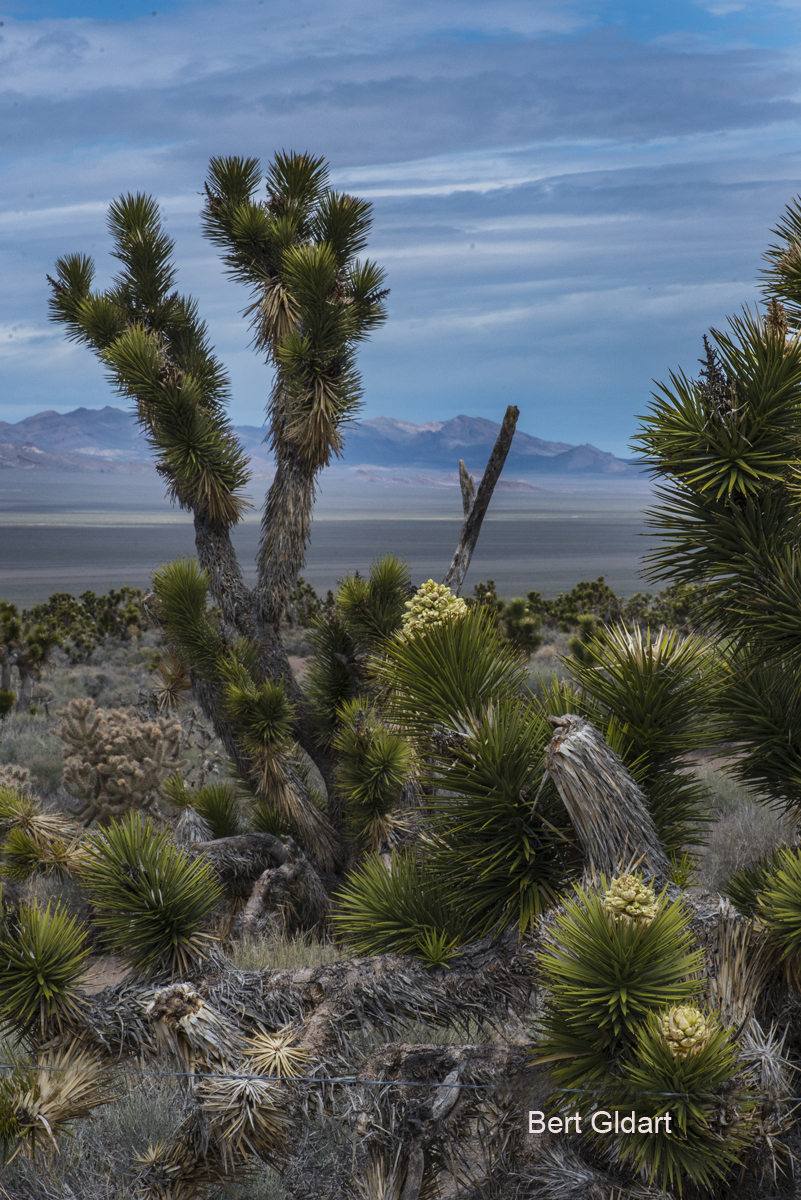
Preserve hosts huge Joshua Trees

Preserve hosts huge Joshua Trees

“We’re working now,” joked Dick, as we passed through an extensive forest of Joshua trees. “Want to stop? Mojave’s got the most extensive forest in the world–and some of the country’s largest specimens.”

We stopped.

DETERIORATING MINES

Many stops later, we arrived at the Death Valley Mines, just off the Cedar Canyon road. Though a family once lived here, today the outbuildings are eroding. Nevertheless, Janie and Linda discovered about a dozen jars of pickled vegetables to include potatoes and cucumbers.

Old canning jars intrigue Janie and Linda

Old canning jars intrigue Janie and Linda

“Don’t think we’ll eat any of these,” joked the two ladies, looking at the corroded bottles.

As well as the general structure, an old grave marker at the base of a Joshua Tree is also eroding, but the inscription pecked into a piece of sheet metal is poignant and still legible. In part, the inscription reads:

In loving memory of husband Lee. May God be with you until we meet again.

Dick examines Death Valley Mines structures

Dick examines Death Valley Mines structures

Departing the mine we returned to the Cedar Canyon road, then traveled east. As we traveled we paralleled the old Mojave Road once used by explorers, trappers and army scouts. Among the list of notables were Jedediah Smith, John Fremont, and Kit Cason, among hundreds of others well known at the time.

The route is one I was particularly interested in learning about and both Linda and Dick wanted to explore it, too, though probably from their jeep. The road is still maintained and one of the more exciting back-country challenges is to drive all that still exists of the old route. It begins at the Colorado River proceeds west and then in about 20 miles enters the Mojave Preserve. From here it proceeds about 80 miles to Zzyzx–at the western edge of the preserve. The name is not an Indian name, rather it was created by a Dr. Springer who wanted a unique name, and his thought was that he could do so if he drew from the last letters in the English language. So far, he’s not had any competition.

Mojave Road

Mojave Road

Though Janie and I have yet to travel to Zzyzx, Dick took time to drive to a segment of the old road, and it appeared as though it might challenge a biker because of the soft sand, and, so, I will be doing some more inquiring. The group of friends with whom I climbed Rainier (links: Rainier & Rainier ) last summer are now looking for a new challenge. “Seems like you’re looking for an adventure,” said Dick, “and not a slog. You may want to test it first in a 4-wheel drive.”

FAMOUS SHOOTOUT

Other stops we made include one at Government Holes. Here on November 8, 1925 is where Matt Burts and J.W. “Bill” Robinson, shot it out. Both were killed. Because the men had been professional gunfighters the shootout has become part of the colorful history of the Mojave Preserve. It was, according to all historic accounts, one of the last classical gunfights of the Old West.

The last excursion of the day took us into the New York Mountains, home too, for many former ranchers–most of whom have allowed the government to buy out their holdings. The road was bumpy, and Dick kept asking how we liked the carnival ride. “We like it,” said Janie,” between her “umphs.”

“Glad to hear that said Dick,” laughing a bit as Linda joined Janie in creating a chorus of “UMPHS.” Dick, who is justifiably proud of his jeep’s comfort, added that it was in part because of the deep shocks, three-inch lifts and the big tires. “Creates a softer ride,” he shouted as we bounced along.

New York Mountains

New York Mountains

As we drove we also took time to enjoy more Joshua Trees, here on the verge of blooming; but our longest stop included a mile hike searching for an old gold mine. The mine was described as the Shelf Mine, and because we did find a huge shelf and the remnants of old mine diggings, we thought we were near. But the day was late, and so we departed.

Dick wasn’t disappointed and said as much. “Now, I’ve got a reason,” he said, “to return to the New York Mountains.”

“As if you really needed one,” we joked.

Read Comments | Post a Comment »

Sands That Sing

posted: March 7th, 2008 | by:Bert

Kelso Dunes and Airstream

Kelso Dunes and Airstream

©Bert Gildart: From our Airstream to the top of the Kelso Dunes is about 660 feet; not far, but the experiences that resulted from the climb were significant.

First, there’s the view that results once you have reached the crest of the dunes. But in this land of perpetual scenery that wows, perhaps even more astounding are the sands that are said to sing.

Though hiking distance is not great, I vastly under estimated the time I’d need to reach the top, for as you approach the crest the sand begins to slide, meaning that you may need two forward steps to advance over what might normally have required by a single step.

But for those interested in hearing the sands sing, sliding is precisely what you want. And that’s what happened.

WHAT MAKES THEM SING?

As I approached the crest, the sand began to slide–and the result was startling. Some have said they hear a booming noise and that’s what I heard. Because there was absolutely no other sound on the day of my climb, the booming might have been startling had I not prepared myself with prior research. Reading indicated the sound could be created by the rapid shear rate–the actual tearing of sand particles one from the other.

Visual Feast

Visual Feast

Others, however, say the sound is related to the thickness of the dry surface layer of sand. When the sands slide, sound waves bounce back and forth between the surface of the dunes and the surface of the moist layer creating a resonance that increases the sound’s volume.

VISUAL FEAST

Though the sound was impressive I was not prepared for the visual feast that greeted me as I crested the dunes–third largest in the nation. It was late in the day and the lighting was particularly dramatic. Stretching before me were miles of rolling dunes, melding one into the other. In turn, they folded into mountain outliers and then–at last–into a major mountain range that could very well have been ranges within Death Valley, some 50 miles or more to the northwest.

Discovering Sand Stories

Discovering Sand Stories

Though it took me almost two hours to make the 600-foot ascent, the return to the Airstream required little more than half an hour. There, I found Janie also enjoying the dunes, but in a slightly different manner. She was studying all the tracks in the sand left by nocturnal creatures.

And that’s a story all of its own.

Read Comments | Post a Comment »

Zen and the Art of Airstream Maintenance

posted: March 4th, 2008 | by:Bert

It's been a good day

It’s been a good day

©Bert Gildart: Actually, this could also have been entitled RV Maintenance 101, but my theme here is that there are some fundamental maintenance procedures that must be performed regularly, else you might loose some mighty precious cargo. I mean that both literally and metaphorically.

Our problems started several days ago when we discovered that not only was one of the taillights on our Airstream not working but neither was the associated brake light. Initially, I thought the problem might be in the actual bulbs, but a friend said “No, it’s probably a wiring problem.”

So we’d been looking around, and yesterday I discovered that the wire connecting our Dodge Pickup with the Airstream had been partially severed right where one of the sway bars and forward part of the Airstream frame are in close proximity. In my haste I had apparently passed the wire between these two components and then, making an extremely sharp turn–something one might do when navigating into a tight campground site–the sway bars had rotated toward the frame thus pinching the wire.

I discovered the partially severed wire yesterday and though it was something I could repair myself, I certainly can’t perform such repairs as quickly as a mechanic. What’s more it was late in the day and we were close to Baker, a small southern California town, and when we saw a garage, we pulled in. Though the garage was a small one, the mechanic had all the right tools as well as the color-coded wire connectors.

CRACKED HITCH

Stopping for repairs was the best decision I’ve made in a long time. The mechanic quickly made the repair, but then as we were hooking back up–passing the connecting wire on the outside of the sway bars–the good man discovered a substantial crack in the hitch, as shown in the accompanying photo. The crack was on both sides of the slide-in hitch.

Cracked Hitch!

Cracked Hitch!

I immediately called George Sutton RV in Oregon, the firm that sold us our Airstream. The service rep said they’d never had such a problem before and that they would check with the company that actually makes the hitch assemblage and see about remuneration. Hitch assemblages are not cheap and run about $700.

Back in Baker now, the mechanic said he was also a certified welder, and that if he wasn’t he would not undertake the job. “I would not,” he emphasized, “send you back on the highway with a problem that could be life threatening.”

ZEN AND THE ART…

An hour later and $100 dollars poorer, we wax philosophical, joking about how I once forgot to inset the cotter pin into the shank of the slide-in hitch that in turn fits into the receiver. I caught that problem, but it became a metaphor for the two of us on travel and on life in general.

We have concluded that we must, on a regular basis, inspect not only the cotter pins on the connecting components of our Airstream and truck, but also the cotter pins of our lives. I guess we could now add wiring and shanks. Pretty corny, perhaps, but it has helped make all of our journeys proceed more smoothly.

And so we were reminded again last night about Zen and the Art of Airstream Maintenance and all of the attendant ramifications. (Robert M. Pirsig’s Zen and the Art of Motorcycle Maintenance is one of my favorite all-time books.) Of course, a little luck is involved sometimes, but tonight we’re counting our blessings.

The sun is setting, we’re camped FREE on a small parcel of our nation’s vast BLM lands, and there is a red glow on the nearby mountains.

It’s been a pretty darn good day.